

It's off to November
Tuesday's primary results are almost all set, setting up a very consequential election season in North Carolina.

Welcome back to Down from DC, where we are following the primary election as the last votes are counted — and some likely recounted.
We are also keeping a close eye on the war in Iran, which President Trump launched into over the weekend without congressional approval. Any major conflict like this has an outsized impact here in North Carolina, home to more than 100,000 troops and their families. We don’t know whether any North Carolina-based troops have been injured in the widening war. The six soldiers killed over the weekend in Kuwait by an Iranian drone were members of the 103rd Sustainment Command based in Des Moines, Iowa. Trump has warned of additional American casualties in a war that could drag on for weeks.
“Most people are really worried about what might happen,” Craig Black, owner of the All American Military Surplus in Fayetteville, told Spectrum News 1. “They’re mentally and physically prepared here at Fort Bragg. But across the community there’s actually a lot of uncertainty about what’s going to happen.”
If you have questions about how the conflict that’s now roiling the Middle East will impact our state, we’re here to help. Send us questions at downfromdc@gmail.com or comment below.
Who won, who lost and who’s still counting
And just like that, it’s general election time in North Carolina. Our state will be among the most consequential in the country this November, and voters knew the stakes: there was unusually high turnout for a primary during early voting, and this trend continued through Election Day, with 1.5 million out of 7.7 million registered voters casting ballots. Democrats and unaffiliated voters who lean Democratic seemed especially energized, with 200,000 more Democratic ballots cast than Republican ones.
Election officials are still counting provisional and absentee ballots and won’t certify the vote until March 13. But most races were settled by early Wednesday morning. Here’s what happened in the highest-profile races for federal office:
At the top of the ballot, Michael Whatley, the former chair of the Republican National Committee who was endorsed early by Trump, easily won the Republican primary for U.S. Senate. Now the race officially begins against former Gov. Roy Cooper, who won the Democratic primary, for the seat being vacated by Thom Tillis.
In the 4th Congressional District, which favors Democrats, Durham County Commissioner Nida Allam conceded Wednesday in a primary she lost by just 1,202 votes to incumbent Democratic Rep. Valerie Foushee.
In western N.C.’s 11th District, Jamie Ager, a farmer whose family has deep roots in N.C. politics, easily won the Democratic primary to challenge Republican incumbent Chuck Edwards in a district Democrats hope they can flip this year.
In the 1st District, U.S. Army veteran Laurie Buckhout won the Republican primary, setting up a rematch with Democratic Rep. Don Davis in a district that was redrawn by the Legislature last year to favor Republicans.
Most of that was expected. But there were some big surprises in primaries for state house and senate seats. At least eight incumbent legislators in both parties lost to challengers, in what the New York Times called a political earthquake. The message from voters, at least in the Democratic primaries, was clear.
“The three House Democrats who were defeated all had one thing in common: they voted with Republicans last year to help override some of Gov. Josh Stein’s vetoes,” Colin Campbell wrote for WUNC.
Those ousters could have big implications for Gov. Josh Stein’s agenda, as well as how Trump’s agenda can affect the state. The veto override votes by the incumbent, centrist Democrats' included votes to move ahead legislation that supported President Trump’s immigration policy, one of the many ways in which the GOP-controlled state Legislature helps advance the president’s agenda. Other examples include redrawing congressional districts to favor Republicans and shifting control of the state board of elections from the Democratic governor to the Republican state auditor.
Then there’s the race that was perhaps the most impactful of any primary in the state, and which likely won’t be resolved any time soon: the most powerful Republican in the state, Sen. Phil Berger, trails Rockingham County Sheriff Sam Page by two votes as of the latest tally. The race has not been officially called – there are provisional and overseas ballots outstanding, and it’s sure to go to a recount, reports WRAL. Berger has been Senate president pro tem since 2010 and went into the primary with the endorsement of President Trump. But Tuesday night, his challenger, Page, the popular sheriff of Rockingham County, declared victory.
“For the sake of North Carolina election integrity, I am hoping against hope that this race doesn’t get thrown to the court system to decide,” Andrew Dunn of Longleaf Politics wrote Wednesday, noting that Berger’s son is a justice on the state Supreme Court.
Paging Dr. Bitzer for a deep dive on turnout
DFDC readers likely know Michael Bitzer, one of our favorite sources for coverage of politics here. He’s the director of the Center for North Carolina Politics at Catawba College, and he’s allowing us to share the initial analysis he wrote early Wednesday morning based on what we knew then. For more by Michael, and to see when he releases his analysis of the official results, follow him here.
When they say ‘every vote counts,’ they literally mean it
With all due deference to the U.S. Senate nomination contests, the real race of the evening was the N.C. State Senate District 26 Republican nomination battle between the most powerful GOP official for the past 15 years, Senate President Pro Tempore Phil Berger, and his home county sheriff and bête noire Sam Page.
When all the precincts reported and the results still unofficial, Page bested Berger by two votes.

Now, as my colleague Chris Cooper rightly noted, this election isn’t done—it’s not certified, there are likely votes out there that have to be considered, processed, and tabulated, the canvassing needs to be completed, recounts, and then any legal challenges posed before we officially know the Republican nominee for Senate District 26.
Specifically, as Chris notes in his way-too-late reflections posted at Anatomy of a Purple State:
Military and overseas (UOCAVA) ballots are still coming in—and may continue to come in through March 12.
Mail ballots that need curing still need to be counted.
Provisional ballots needs to be counted (if they’re found to be accepted)
Canvass, “the official process of determining the votes have been counted and tabulated correctly, resulting in the authentication of the official election results.” occurs ten days after the election. It will be open to the public.
Because, even after all of that, the results will almost certainly be within one percentage point, there will then be recounts.
Then there’s the possibility (read: near-certainty) of legal challenges after all of that is over.
And, here’s a fun/terrifying additional one. The Yoda of North Carolina election law, Gerry Cohen, tweeted that “under a 1915 law, if there is a tie in a multi-county state senate race there is no recount—instead there’s an automatic second primary. If there’s a tie in the second primary, the primary is vacated and the party executive committee chooses the winner and is not limited to the tied candidates.”
In other words: stay tuned folks. The band at this rager ain’t done playin’.
U.S. Senate Primaries play out as expected for nominees, but not for voters
The tradition in North Carolina primary politics is that the party with the perceived ‘more competitive’ top-of-the-ballot contest draws the most attention/ballots. And that’s to be expected. And conventional wisdom was that this year the competitive contest was on the Republican side of the ballot.
Until 2026 said, yea, not so much.
Again, with unofficial results and counts, here’s how each party’s U.S. Senate contest played out in terms of ballots cast:
Republican U.S. Senate: 625,667
Democratic U.S. Senate: 824,798
Nearly 200,000 more ballots were cast in the Democratic primary than in the Republican, with the total percentage split going 57-43 between the two major parties.
And across the state, the pattern is fairly predictable when it comes to where Democratic primary ballots outpaced Republican primary ballots, and vice versa:
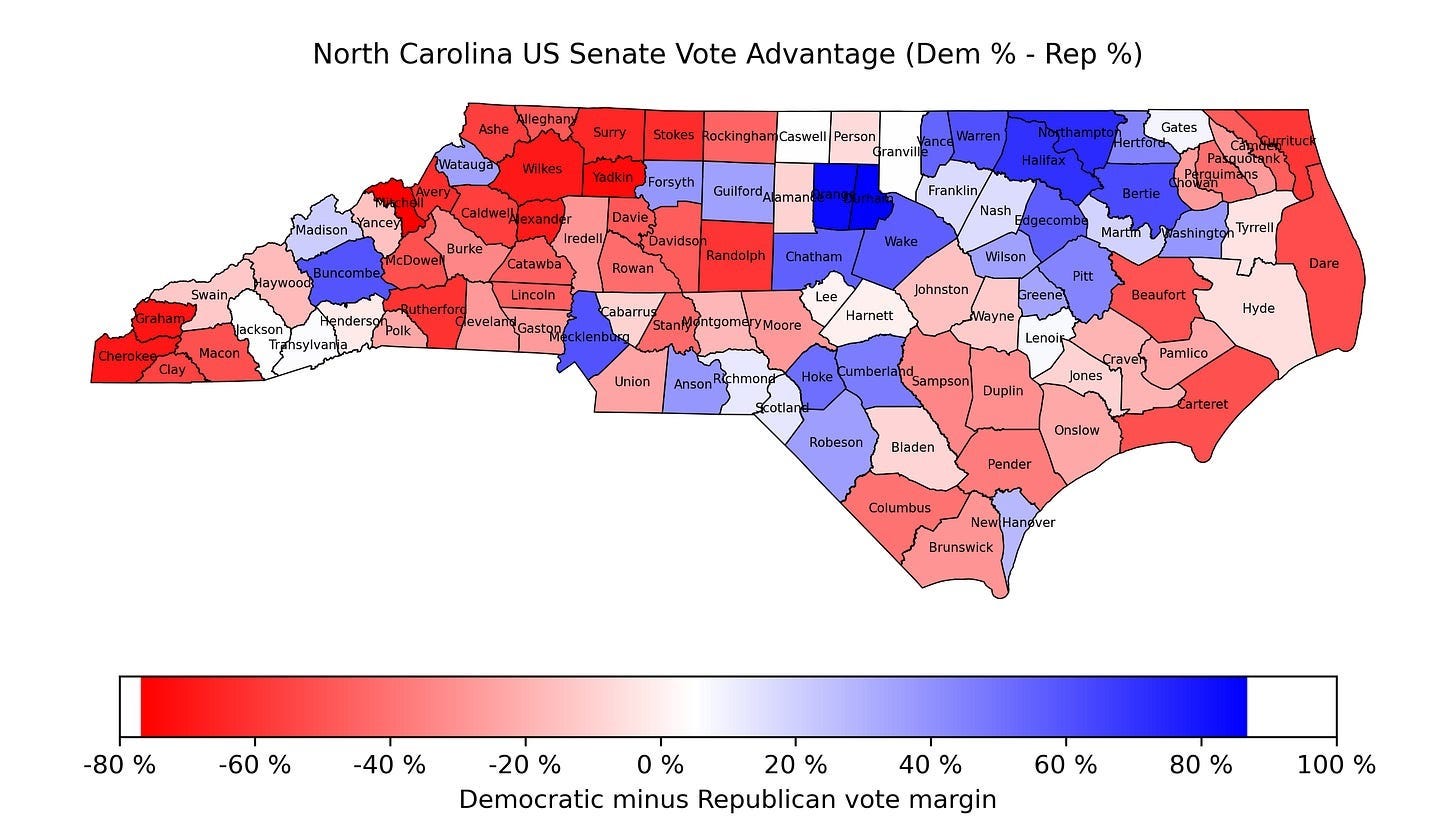
The dominant Democratic urban counties, followed by the majority-minority counties of the upper northeast of the state, resemble a very typical pattern in N.C. county electoral patterns, along with the swath from the upper northwestern mountain counties slicing down in the central Piedmont region (basically Ashe cutting down to Randolph).
One stretch of counties is somewhat interesting at first glance: along the eastern South Carolina border, the range of Anson through Robeson is notable, as these rural counties had been trending more Republican in general elections, but Democrats had more primary ballots pulled. This may be something to watch come November.
One other set of notes: on the Republican side, Whatley secured 65 percent of the GOP primary vote. That’s right in line with my thinking about Republican primary electoral dynamics, where the Trump-endorsed GOP candidate garners two-thirds of the primary vote to everyone else. That fits a pattern going to 2022’s GOP nomination contest, with Ted Budd (as the Trump endorsee) and Mark Walker seeking the ‘Trump lane’, while in 2024, Mark Robinson carried that mantel and secured two-thirds of the vote.
On the other side, for a contest that ended up being a coronation for Cooper (92 percent of the vote), the Democratic primary’s energy in attracting voters (with a turnout rate of only 20 percent, same as four years ago) is something to consider as the lead-off in the general campaign (and yes, that begins today).
It’s not just party loyalty among the voters, it’s party adherence for elected officials
In today’s political environment, it’s not just the voters that are party loyalists in their habits, but nowadays the expectations are that elected officials will ‘toe the party line’ and not crossover to work with the other side of the aisle.
Three test cases of that dynamic were on full display last night, and the resounding answer from the primary voters was “toe the line or you’ll get the boot.” All three Democratic legislators who voted for overrides of their governor’s vetoes were summarily excused from renomination. And a fourth Democrat, trying to make a comeback after having been dismissed in 2024 for bucking his party, failed as well.
And it’s not just on the Democratic side enforcing compliance. The Republican House Freedom Caucus leader, Keith Kidwell, was defeated in his renomination bid for State House District 79 in what appears to be an intra-party fight against a fellow Republican representative and party leaders.
As a political scientist, I’ve noted the fact that the parties and voters have been sorting themselves for some time, and with that sorting comes party loyalty tests and allegiance. Tonight’s results show that when some officials buck their party, the party kicks back.
Now, the real fun begins: on to November.
Once the recounts, canvassing, and certification of the official winners is completed, some will say “it’s off to November.”
But for me, that chant begins today.
It looks like what we were expecting for November was set up in the primary:
Cooper versus Whatley for the U.S. Senate, with expectations of being one of the most expensive contests in NC (maybe US?) history
NC’s First and Eleventh Congressional Districts have their prime-time candidates on both sides
Again, pending resolution of Berger-Page, is there a new dawn in #ncpol that comes with the defeat of the most powerful Republican elected official in the state? And the mad scramble to garner the state senate reins of power?
Democratic enthusiasm is notable—is it sustained over the next nine months when they need their voters to show up and counter the built-in Republican registered voter turnout advantage in the general election?
Lots of questions, with future discussion (and sleep) to be considered.
Thanks again to Michael. You can find more of his work here. We’re taking next week off and will be back later this month with more political analysis and more discussion of how the news out of DC affects us here in NC.